Self-Reflection: Yoga’s Secret Weapon
Feathers
The way common birds flit around and sing to each other always reminds me how we’re all connected. Sparrows and finches help me know I’m not alone.
The birds of prey: hawks, eagles, falcons, feel like protectors to me. They let me know I’m supported.
When a raven or a crow flies near I know to listen up because a message has been sent from the Void.
But a Heron? Hmmm. Though I consider birds my angels, I never had a connection with this stilt-legged water bird.
Healing Medicine
In Native American traditions, animals, including birds, each have their own “medicine.” According to authors Jamie Sams & David Carson in their collection of Medicine Cards, medicine “is anything that improves one’s connection to the Great Mystery and to all of life. This would include the healing of body, mind and spirit. This medicine is also anything that brings personal power, strength and understanding.”
The lore around the Heron is associated with self-reflection. Heron’s walk is slow and methodical, a meditation of movement. Sometimes he stands statue-still peering at his own image in the silver surface of the water.
In The Mirror
Looking at our experiences, thoughts and actions, we mimic Heron gazing at the water. We see ourselves reflected through the mirror of our relationships with others and with life, and we see ourselves more clearly.
Not a cloudy view of self-importance but a crystal-clear view of what needs improvement or change. Not heavy with self-pity, but openly taking responsibility for who we are and developing the courage to become ourselves.
Self-reflection is the best secret weapon we could have. When we know and love ourselves, including our weaknesses and skills, no one can hurt us. Making fun of something we already know and accept takes the wind out of the sails of any aggressor.
When we know and love ourselves, we can move through challenges more easily. We hold fast to our inner connection, like an anchor, even when the sea rages around us.
When we know ourselves we can act ethically, with honor and integrity; we become strong in mind and heart, but soft with openness and humility.
Know Thyself
In yoga we practice Heron medicine in two main ways: self-study (swadhyaya) and directing our attention within (pratyahara).
Swadhyaya is a study of the True Nature of the universe. Classically, one would read yogic texts and learn of how the Divine exists in and interacts with the world. Beyond book understanding, the goal is to see Spirit in nature and, more importantly, within ourselves.
Socrates great statement, “Know thyself,” implies a deeper questioning. Why is it important to know ourselves, to be at peace with the Great Mystery and see God within?
When we know who we are, we move from child to adult, and into living with purpose and direction. Without self-knowledge we cannot act deliberately, ethically or in alignment with anything. With self-knowledge we make conscious choice and move deliberately towards freedom.
As part of the yoga of action (kriya yoga) this practice becomes one of wholehearted dedication to the Truth in all. Actions that uphold this Truth would be: love, honesty, taking the high road, gratitude, observing the awe-inspiring beauty of nature, reverence, wonder, openness, curiosity, respect, humility…
Acting in Balance
Pratyahara means “to draw towards the opposite.” In daily life, our senses are constantly drawn out, pulled into the world by colors, sounds, music, voices, aromas.
The mind moves to categorize, describe, relate to and understand all these things. Interpretation is necessary and even desired, but if it’s all we do, it puts us out of balance and steals the opportunities to simply enjoy things rather than always needing to describe them.
When it comes time to be still and quiet, to meditate or simply to hear the whisper of dreams that lie hidden within, we can’t seem to get the mind to shut up. As per BKS Iyengar’s book Light On Life, “The yogic purpose of pratyahara is to make the mind shut up so we can concentrate.”
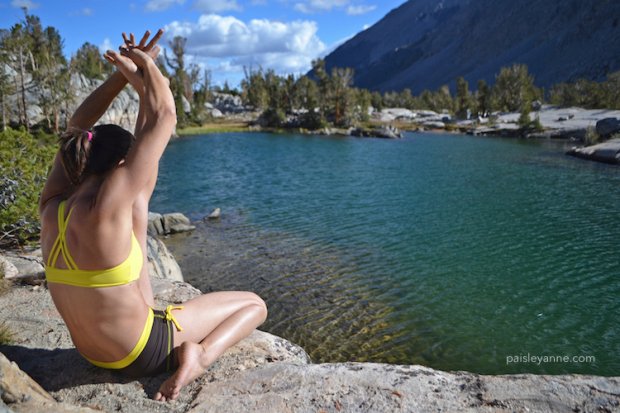
Krounchasana (Heron Pose) : Gem Lakes, Rock Creek, CA
Instructions for Krounchasana:
Warm up with preparatory poses that open the hamstrings, low back, front of the thigh and the shoulders. Consider: downward dog, pyramid pose, runner’s Lunge + hamstring stretch, hero’s pose, one-legged reclining hero’s pose, forward fold (seated or standing).
- Fold your right foot back into virasana (hero’s pose). Prop your hips on a block or pillow if this makes you really lopsided.
- Bend your left knee and pick up your left foot.
- Keep the leg bent and pull back on it so your knee moves to the outside of your left armpit, the leg will be slightly turned out.
- Sit up as straight as you can.
- Pull back on your foot with your hands, and at the same time push your foot into your hands until you feel your thigh bone move back in your pelvis, and the muscles all around your leg engage.
- Keeping the muscles of your leg active, begin to stretch your leg straight, aiming towards about 45º from the ground, with arms straight.
- Lift your back ribs and chest up and continue to pull/push on your foot.
- As your body opens, begin to move your shin and your head towards (or to) each other, bending your elbows as you go.
- Whenever you reach your limit in Heron Pose, hold there for 30 seconds to a minute and take several deep breaths.
- Turn your attention inwards, perhaps even close your eyes and reflect on your breath, where you are in this moment, and what goals and dreams might be hidden in your own heart.
