Make Meditation Easier
Meditation is a powerful tool for centering and connecting with ourselves. Yet, making that connection can so easily be lost in the discomfort of sitting. When sitting is a challenge, instead of listening to the rhythm of our own breath, or being witness to our thoughts, all we think about is how uncomfortable we are.
Stretch Out
One of the best ways to prepare to sit is by stretching out our bodies. (You’ve heard of yoga poses, right?) Anything that loosens the hips and hamstrings is especially good. Poses that help open and lift the chest help, too. Some of my favorite poses that do both are: Parsvakonasana (Side Angle Pose), Trikonasana (Triangle Pose), Adho Mukha Shvanasana (Downward Facing Dog), Uttanasana (Standing Forward Fold) and Adho Mukha Eka Pada Rajakapotasna (Downward Facing Pigeon Pose).
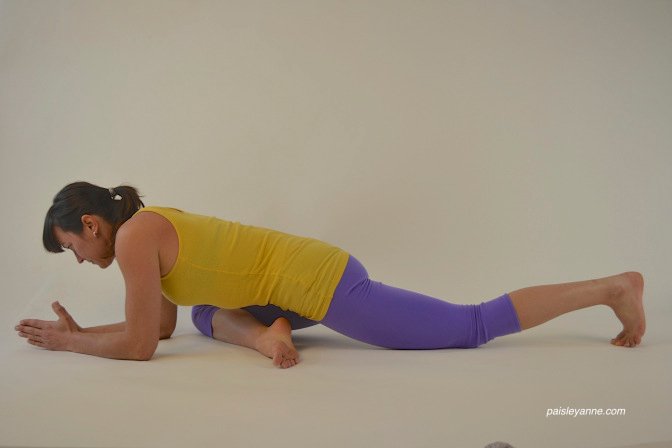
Downward Facing Pigeon Pose
Brace Yourself
Classically meditation is done sitting on the floor. One reason is so we remain mentally alert and attentive to what we’re experiencing, thinking and feeling. But if you’re new to sitting on the ground, it can be downright painful. Try bracing yourself by sitting with your back against a wall. Another good option is to sit in a chair. Just make sure you aren’t slouching!
Knees & Hips
When we’re tight in our low backs or hips, sitting up straight requires more effort. Over time, that effort makes our backs tired. Our minds, instead of being calm, will then be agitated by the discomfort and fatigue. A simple solution is to sit cross-legged with our knees at or below the level of our hip bones. The easiest way to get this alignment is to sit on some sort of lift, like a pillow, a couple of folded blankets or a zafu. Doing so drops the knees down and places the low back in a more natural curve.
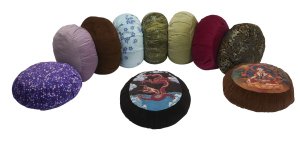
A Collection of Zafus
